
Personal Loan APR vs Interest Rate: Understanding the Actual Borrowing Cost

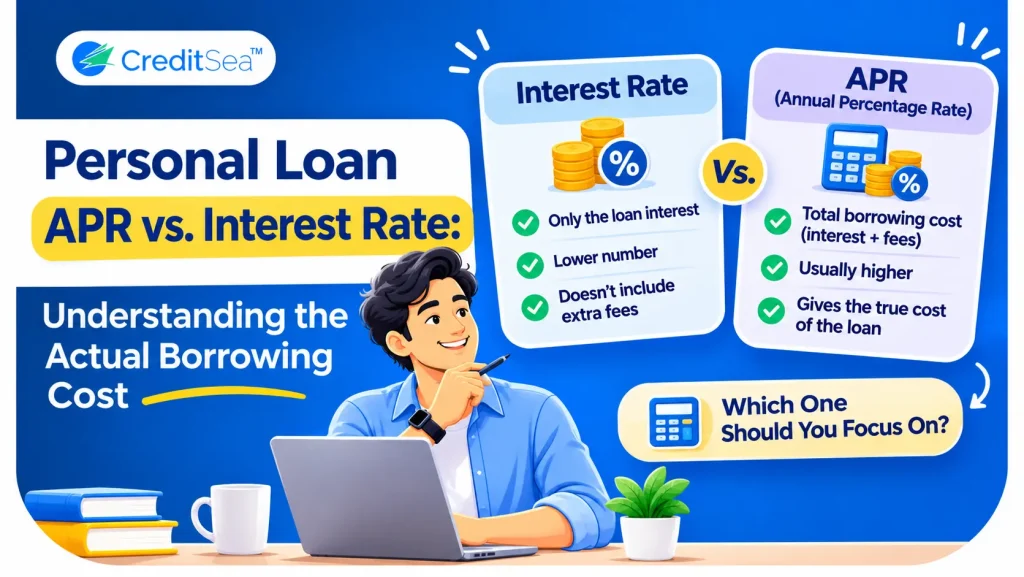
Two lenders, two advertisements. One says “Personal loans from 11.99%.” The other says “Rates from 13%”. The first looks cheaper so you click. But the number in the ad is seldom the number that appears on your repayment. The difference between them is the difference between the interest rate and the APR. Knowing about it can save you real money.
What Is the Interest Rate?
The interest rate is the cost of borrowing the money itself, expressed as a percentage per annum. It’s applied to your outstanding principal, and it’s the number most lenders advertize.
But on its own, it’s incomplete. A low interest rate loan can be expensive if it includes processing fees, documentation charges and taxes. And flat rates, be careful with them as well. The flat rate means you’re paying interest on the original amount for the whole time, even as you pay it back, so you’re actually paying way more than the number suggests. A reducing-balance rate charges you interest only on what you still owe, which is fairer and is what most digital loans do.
What Is APR?
APR is Annual Percentage Rate. The RBI defines it as the annual cost of credit to the borrower, which includes the interest rate and all other charges associated with the credit facility. Simply put, it’s the “all-in” cost of your loan, expressed as a yearly percentage.
This is important, because lenders need to see this. In Feb 2024, the RBI decided to make it mandatory for regulated lenders to provide a Key Fact Statement (KFS) on loans to retail and MSME segments. The APR is on the KFS and it’s the best single number for comparing offers.
What’s Inside APR, and What’s Left Out
Included in APR:
- Rate of Interest.
- Processing fees and other fees that are not contingent.
- Third-party charges collected by the lender, such as insurance or legal fees.
Not included in APR:
- Penal charges. Charges tied to events like default must be disclosed, but they aren’t part of APR. So don’t assume APR already covers what you’d pay after a missed EMI.
- Prepayment or foreclosure charges, which are generally excluded because they’re conditional.
Here too RBI protects you. Nothing not listed in the KFS can be charged to you at any time during the loan. And penal charges are kept separate from the interest rate and are not compounded.
A Worked Example: When the Lower Rate Costs More
Here are two illustrative ₹1,00,000 loans over 12 months. These are my own calculations with assumed numbers, not CreditSea offers.
| Loan A | Loan B | |
| Interest rate | 15% a year | 16% a year |
| Processing fee | 2% + 18% GST = ₹2,360 | None |
| Amount you receive | ₹97,640 | ₹1,00,000 |
| Monthly EMI | About ₹9,026 | About ₹9,073 |
| Total interest + fees | About ₹10,670 | About ₹8,880 |
| Approximate APR | About 19.6% | About 16% |
Loan A has the lower interest rate and the higher actual cost. You receive less money due to the fee, but repay as if you’d borrowed the entire ₹1,00,000. That’s exactly the hole APR aims to uncover. In the case of just comparing rates, you’d pick Loan A and pay roughly ₹1,800 more.
Why the Two Numbers Differ
Three things widen the gap between interest rate and APR are:
- Upfront costs. Some processing fees and charges take a cut of the money you get.
- Tenure. A flat fee has more effect on a short loan than a long loan, as it is divided by fewer months.
- Fees taxes. The total is increased by GST on charges and the KFS shows how it is treated.
It’s a technical calculation. APR is calculated based on the net disbursed amount and your repayment cash flows, using an internal-rate-of-return methodology on a reducing balance. That’s why you shouldn’t try to reverse engineer it. Instead read the figure in your KFS.
How to Compare Loans Using APR
- Get the KFS before you accept. It should show APR, interest rate, fees and repayment schedule all in one place.
- Compare APR to APR. Use similar amounts and tenures to make the comparison valid.
- Check the net amount paid out. See how much of it actually makes it into your account after deductions.
- Read the penalty and prepayment terms separately. They sit outside APR but can be important if plans change.
- Check the EMI for sanity. A low APR is no good if the instalment is too much for your monthly budget.
Common Mistakes to Avoid
- Choosing by the advertised rate. The ad is a starting point, not the total cost.
- Ignoring the fee line. A 2% fee plus GST is easy to miss and costs real money.
- Comparing different tenures. A short loan and a long loan aren’t comparable on interest alone.
- Assuming APR covers everything. Late charges and some other conditional costs aren’t included.
Quick FAQs
Is APR always higher than the interest rate?
Generally yes, when a loan has upfront fees. With no fees, the two can be close.
Which should I trust, APR or interest rate?
Use APR for comparing total cost, and the interest rate to understand how interest accrues.
Where do I find my APR?
In the KFS, which lenders must provide before you sign.
How CreditSea Fits In
CreditSea acts as a Lending Service Provider (LSP) and connects you to RBI registered NBFC partners. The application is digital, no paperwork drama, and each offer comes with a KFS so you can see the APR, fees and total repayment before you decide. The lending partners then perform their own credit assessment and present offers, so the real rate and APR differ from borrower to borrower.
The Bottom Line
The interest rate tells you how much money costs. The APR tells you the cost of the loan. Before you take out any personal loan, find the APR in the KFS, compare it across offers and check the amount that actually hits your account. That one habit can make a good looking ad into a truly good deal.