
Repo Rate and MCLR: How RBI Rate Changes Affect Your Loan EMI

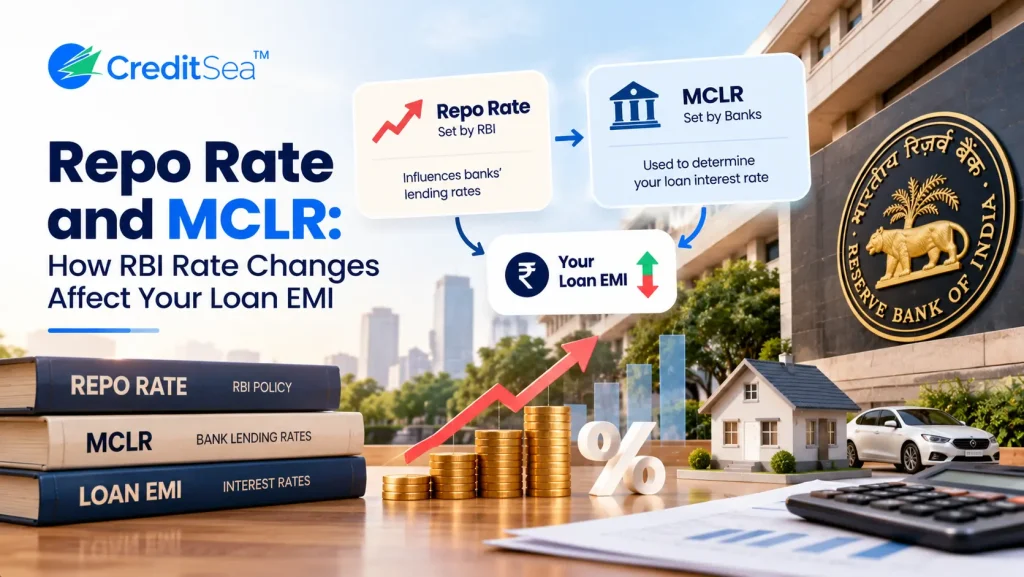
Your loan EMI might look manageable today, but what happens if the interest rate changes?
Imagine that you have a home loan, car loan, or another floating rate loan, and a decision by the RBI can affect how much interest you will pay over time.
But remember, the impact depends upon the benchmark that is linked to your loan.
A repo rate is the rate at which the RBI lends money to other eligible banks against securities. MCLR, which is Marginal Cost of Funds Based Lending Rate, is an internal benchmark that the bank uses to determine the lending rate for certain types of loans, while the repo rate is set by RBI by using the inflation, economic growth, and other factors.
So understanding the difference between these two rates will help you make sense of the interest rate announcement and track changes that happen to your loan, and you can plan your monthly budget according to that.
As of now i.e., October 07, 2026 repo rate has been hiked by RBI from 5.25% to 5.50%. So this does not mean that every borrower’s EMI will be immediately affected by this. The effect depends on whether the loan is linked to the external benchmark, such as the repo rate, or internal bank benchmark such as MCLR, along with the loan terms and the repayment schedule.
What Is the Repo Rate?
The repo rate is the RBI’s policy rate under which they lend money to banks through the repo operations. They provide fund to the eligible banks under the eligible securities under the Liquidity Adjustment Facility. This is one of the monetary policy tools that the RBI uses to influence your borrowing cost, credit condition, inflation in the economy. So when the RBI changes the repo rate, that can influence the interest rate that banks offer to their borrowers.
Why Does the RBI Change the Repo Rate?
The RBI repo rate changes under the RBI’s Monetary Policy Committee (MPC) that reviews economic condition, including the inflation, economic growth, before making any monetary policy decision.
- When the inflationary pressure rises, the RBI might increase the repo rate to tighten the financial condition and moderate the demand.
- When economic activity needs support, the RBI might reduce the repo rate if the inflation outlook and the other economic condition allow that to happen, making the borrowing more cheaper for people over time.
- When the conditions are uncertain, the RBI might keep the rate unchanged based on the new economic information that they have assessed.
These results are not automatic. A repo rate decision is made carefully based on the assessment of RBI of our overall economy, and it affects the lending rates, depending on how banks transmit the change.
What Is the Current Repo Rate of RBI?
As of October 7, 2026, the current repo rate of RBI is 5.50%. The MPC has increased it by 25 basis point from 5.25% at its October 5 to 7, 2026 meeting. 100 basis points make 1 percentage point. Therefore, a 25 basis point increase means the rate has risen up by 0.25 percentage points. So, since the repo rate can change at future policy meeting, check the RBI’s Official website for the latest announcement before you rely on this figure.
What Is MCLR?
MCLR means Marginal Cost of Funds Based Lending Rate. This is an internal benchmark that the banks calculate using the marginal cost of funds and other components. This includes the negative carry on account of Cash Reserve Ratio, CRR, operating cost and tenor premium. So, in simple terms,
MCLR shows the cost-related factors that a bank considers when they set its lending benchmark. The interest rate on the loan is linked to MCLR, which is generally determined by adding the applicable spread to that benchmark.
The banks publish MCLR rate for different tenors, such as overnight, one month, three months, six months, or an year. So the applicable rate depends on the benchmark that has been set and the terms that are associated with the loan. So, for example, if a bank’s applicable one-year MCLR is 8.50% and the contractual spread on a loan is 1.50 percentage points, that would be resulting in interest rate of 10% per annum.
This is just an example, illustrative calculation, not the current offer from any particular bank. MCLR is reviewed and published by the banks periodically. So a change in bank’s MCLR doesn’t mean that every existing borrower interest rate will be affected immediately. The loans reset date and contractual terms matter in this.
RBI prescribes the method for calculating it, and it works as the minimum interest rate for the loans linked to it.
How Do RBI Repo Rate Changes Affect Loan EMIs?
Since October 2019, new floating rate retail loans are linked to an external benchmark such as the repo rate, and not to MCLR. So these loans react to a repo rate change faster, as the rate is reset at least once every three months.
When the repo rate increases?
So, that just means that the banks are borrowing from RBI at a higher rate. So this has become expensive for banks. So this might result in them pushing up the lending rates. So if you have a floating rate loan that is linked to a benchmark, which reflects the increase, then your interest rate might rise. But depending on your loan terms, your EMI might increase or your repayment period might become longer, or both can maybe adjust it.
When the repo rate decreases
If it decreases, the banks will be able to access the fund at a much lower cost, which will be cheaper for them, and this will encourage them to reduce their lending rates. So if you pass on the reduction to your floating rate loan, your interest can reduce in this case. This could reduce your EMI or even the time taken to repay the loan depending on your loan terms.
When the repo rate remains unchanged.
In this situation, if the RBI has decided to maintain the existing repo rate. So this doesn’t mean that your loan interest rate will stay the same. Your banks can still charge its lending rate for other reasons, which depends on the benchmark and your loan terms. So an unchanged repo rate alone doesn’t trigger a repo rate-driven change in your EMI.
How Does a Repo Rate Change Affect MCLR-Linked Loans?
The relationship between them is less direct for a loan that is linked to MCLR.
The hike in the repo rate by the Reserve Bank of India (RBI) could lead to a change in funding costs and other financial conditions of the banks, which might affect their MCLR. But the relationship is not one to one. So an increase of 0.25 percentage points in the repo rate doesn’t mean that your bank must increase its MCLR by exactly 0.25 percentage points.
So similarly, when the RBI reduces the repo rate, a bank’s MCLR may not fall by the same amount or immediately.
What Are the Reverse Repo Rate and Bank Rate?
The reverse repo rate is the rate which is applied when the RBI borrows fund from the commercial bank. It is used to manage the liquidity in the banking system. In a repo, RBI provides fund to the banks, and in reverse repo, the RBI takes the fund from the commercial bank. Today, the Standing Deposit Facility (SDF) is RBI’s primary tool for absorbing the liquidity without providing any collateral, so if you search for the reverse repo rate, make sure you do not confuse it with the SDF rate.
Bank rate is also set by the RBI. It is associated with the RBI’s lending framework, outside the regular repo operation, and it is also used for certain regulatory purposes. Although the bank rate and repo rate are both policy rate, they are not interchangeable, and their levels and role within the monetary framework differ. A change in one should not be treated as an identical change in all of the others.
FAQs
What is the repo rate?
The repo rate is the interest rate at which RBI lends money to commercial banks, it affects the financial conditions and can have an impact on the borrowing costs for loans which is linked to the external benchmark.
What is the repo rate at present?
As of October 7, 2026, the RBI’s policy repo rate is at 5.50%, an increase of 25 basis points from 5.25%.
How will a change in repo rate impact the EMIs of loan?
In case of a change in the repo rate, the EMIs of floating rate loans linked to the repo rate will be affected only if the change is passed on as per the terms of the loan. The adjustment can affect EMI, the remaining tenure or both depending on the process followed by the lender. Loans linked to MCLR may behave differently.
What is MCLR?
MCLR means Marginal Cost of Funds Based Lending Rate, it shows the cost-related factors that a bank considers when they set its lending benchmark. The interest rate on the loan is linked to MCLR, which is generally determined by adding the applicable spread to that benchmark.
Must Read – What Is CKYC? How to Find and Use Your CKYC Number
Conclusion
The repo rate and MCLR both explain how interest rates work but have different effects on the borrower.While repo rate is a policy rate of the Reserve Bank of India (RBI), MCLR is an internal benchmark that is calculated by the banks.” The effect on your EMI will depend on the benchmark, interest rate structure and reset terms of your loan.
If you already have a loan, check your loan statement and loan agreement to see what your current rate and repayment schedule is. Compare the interest rate, total cost of repayment, charges that may apply and ability to pay the EMI, before saying yes to an offer, if you are thinking of borrowing.
With this knowledge you will be better equipped to plan your finances each month, and make smart decisions about borrowing.